Showing posts with label jack-in-the-pulpit. Show all posts

Monday, October 17, 2011

Back into the Woods

Autumnal rain fell with the leaves yesterday and the day before but today misty drops were replaced by a sunlight shining golden through my morning window.
Pulling my hiking boots from the closet, I laced them up then after tying a double knots I joined the sun.
No, it is obviously not native but yes, I planted a banana tree in the field near the New Woods.
It grows very slowly in the poor soil. If it ever poses a threat of invasion I will simply mow it down or dig dirt away from the roots. It is barely hardy in our area and spreads only by growing a larger root mass.  I approached the tropical foreigner and noticed something interesting.
Something was eating the banana leaves. It was something with teeth, not bugs. I was curious since it  is a non native and the leaves are so very tough.  For now it will remain a mystery.
There is some summer color remaining in the woods. First, I spied a couple violets.

Some small white asters and the larger Wood aster (Divaricatus)


as well as a flower as golden as this morning's sun, Wingstem (Actinomeris alernifolia)
We have seen plenty of honeybees this year - a welcome sight.
As I walked on I saw a spot of woods poking out from under some brush.  Do you see it?
Look a little closer
I'm pretty sure it is a large Jack-in-the-pulpet but I really want it to be Ginseng.  All the Jack-in-the-pulpets I've seen in this area are a small type with small berry stems. I think, though, that the way it is clustered on the stem is particular to Jack-in-the-pulpet.  The examples of Ginseng I have seen are more rounded clusters.
Aw, well, it is time to take a last look at the woods and turn toward home do some chores.
don't fret, we'll go out at least one more time before all the leaves are gone.
-------------------------
Once again,  I am including the link to this album below because I heard the band last weekend and loved it.  I wish you could have heard them.  One day you may hear them on the radio. HaHa Tonka is named after a park in Missouri.  They are Indie Folk/Rock with an unbelievable 4-part harmony on some of the a cappella tunes.  they are full of youthful enegry which they mesh with traditional Ozark Mountain music sounds. Once again, I am includeingthe link to this album below because I heard the band last weekend and loved it. 

Tuesday, May 31, 2011

Across the Border

Paw paw
Paw paw
Yesterday I showed you the plants I found just across our property line. Let me add a scary story to that.  The whole property was slated for timbering last year.  The timbering had even begun. For two days I moped and cried as the tractors moved in.  Luckily, they started near the gas line an hadn't progressed very far when it was discovered that the logger had no valid license or something like that. This year? So - far - so - good.
Now, lets step back onto the home plot, our piece of land which has been routinely pillaged. Most the hill tops around here were clear in the early 1900's.  What wasn't grazing land was planted in orchards. Around that time, something happened to the fruit market and the orchards and/or their owners fell into disrepair.  When I moved here thirty-two years ago there were still five or six trees on the top of our hill. Now there is one, probably just a child of those early orchards.
So, would any of those more sensitive plants have found a comfortable home in which to prosper? Come with me and we'll see . . . This looks promising.
right away I found some immature Jack-in-the-pulpits. Hooray!
My experience tells me that this is one of the first "deep woods" plants to grow. I suppose it can handle more sun than some of the others. Oh look! here is one with a "jack." Do you see what is growing beside it?
That leaf with its deeply cut lobes is bloodroot! Its seed pod is full of maturing seeds which will soon be carried away by ants who will eat the fat from around the seed then throw it in the ant garbage pile where it will, hopefully, take root and grow.
This fungus is pretty neat too.
Here is a close up, though it gets a little fuzzy.
This is great fun!  We hardly have to move and we see all kinds of stuff.  Look at that bank over there speckled white with violets.
And there to the right . . . that's an Oxalis, Wood sorrel.
Delicate pale pink flowers flare outward.
It doesn't all look the same, does it?  As we push on through the tangle of branches we see these Wood sorrel plants . . .
Is it a mutation or something different in the soil that makes those distinctive red lines on the leaves? Or could it just be a different variety.  Do you know? 
This next photo shows my favorite find today! 
Maidenhair fern (Adiantum pedatum) growing right amidst Jack-in-the-pulpits and bloodroot! 
Our day is good - and we have a ways to go before we get back to my garden so don't leave me yet.
     

Monday, May 30, 2011

Last Spring Walk


A-a-h-h-h, Spring, There is no better place to be than in a temperate climate during the spring. Spring gives us cool, crisp mornings with clear sunny days.  A different plant blooms each day.  Each morning brings a new bird call to our ears. But the season is much too short.
Today, the calendar says "spring" but the thermostat says here in the mid-Ohio valley we have moved beyond that.  Here is your chance to dawdle in our late spring woods for my last walk before the temperatures soared into the 90's as they are today.

2011 Spring has brought us a climate more like the Pacific Northwest than what is normal here.  All that moisture has resulted in an explosion of mushrooms, tree ears and all sorts of fungi.  This beautiful brown one was squeezed out of a crack in a dying tree. Its skin, like the fur of a woodland mammal caught my attention through a thick patch of multi-flora rose. 
A few weeks earlier I had found an area of woods with flowers I had never seen on our property.  The problem was that this was not our property. 
Wild Oats (Uvularia sessilifolia)

Here, the woods have been left un-timbered for over forty years, leaving the forest floor shaded with no briars and grasses to compete with more sensitive plants such as this Solomon's seal (Polygonatum biflorum).  I have often searched for this plant through the thirty-four years I have lived here. It delights me each time I discover something new right under my nose.

We have plenty of False solomon's seal (Maianthemum racemosum). Notice that the flower is at the tip of the leaf stem rather than hanging beneath the plant as in Polygonatum biflorum.

Tiny Jack in the pulpits (Arisaema triphyllum) grow all over this section of the woods.  This particular type stays tiny, no taller than seven to ten inches.
Tomorrow, we'll continue onward, stepping across the property line to see what awaits us.  
Enjoy the rest of your Memorial Day weekend.

Friday, August 13, 2010

Afternoon in August

In August, plants don't make the grand entrance that gives us the great show of spring.  Flowers that bloom in late July and  August tend to sneak into my garden. quietly growing all summer amid the fading leaves of earlier bloomers.  It seems that one day I just realize they are there covered with blooms like the purple aster or this lily below.
Belamcanda chinensis - Blackberry Lily

Not a lily at all, but actually an iris, the Blackberry lily grows wild in West Virginia. Stems and leaves first appear in June.  At this point it looks like a petite iris.  from between the lance-like leaves a stem appears which grows tall.  Mine is about four and a half feet. The fun begins when the flowers pop out of the stem. Brilliant candy orange blossoms carry orange spots. Each petal curls slightly at its tip like a dog's ear. The budding performance does not stop with a fully open flower. Once the flower fades, it curls up on itself looking like an old-fashioned candy stick.  This swirl sits atop the seed pod which continues to swell until it is filled with purple-black seeds that burst forth when the pod of broken.
 
 Many of the spring flowers are gone by August, but Jack-in-the-Pulpit is still entertaining as it forms berries along its stem or "pulpit."  First green then red, the berries draw my attention into shady spots. 

The Jack's leaves have disappeared around its stalk of berries. This particular plant is part of the very first  plant to become part of my garden.  I was given it during a wildflower class. The tiny jack-in-the-pulpit was wrapped in aluminum foil. To me it was a rare treasure. Since then I have found many in the woods around my home and have transplanted several into the garden. Most do not get as large as this one. Several shoots and leaves emerge from the original plant. The largest one is first to turn red and drop to the ground.  Its stem has dried so that now the weight of the berry head bends it over where each berry will fall to the ground at a different time.  I think this gives a greater possibility that one or more of the berries will fall at the perfect time when the ground has just the right amount of moisture to allow the seed to germinate or let itself be buried to wait out the winter cold.
Other Jack plants do not yet produce berries, but do hold on to their leaves almost until frost.
Each August day brings a new surprise as plants bloom and mature intermingled with each other, just waiting for me or someone else to discover what the garden holds.


Wednesday, May 19, 2010

Night Walk Continues

Let's continue our night walk through the woods for one more day. That is about all the time we have left before the sun goes down completely.  Things look different at night when we lose familiar backdrops and surroundings. Grass becomes art
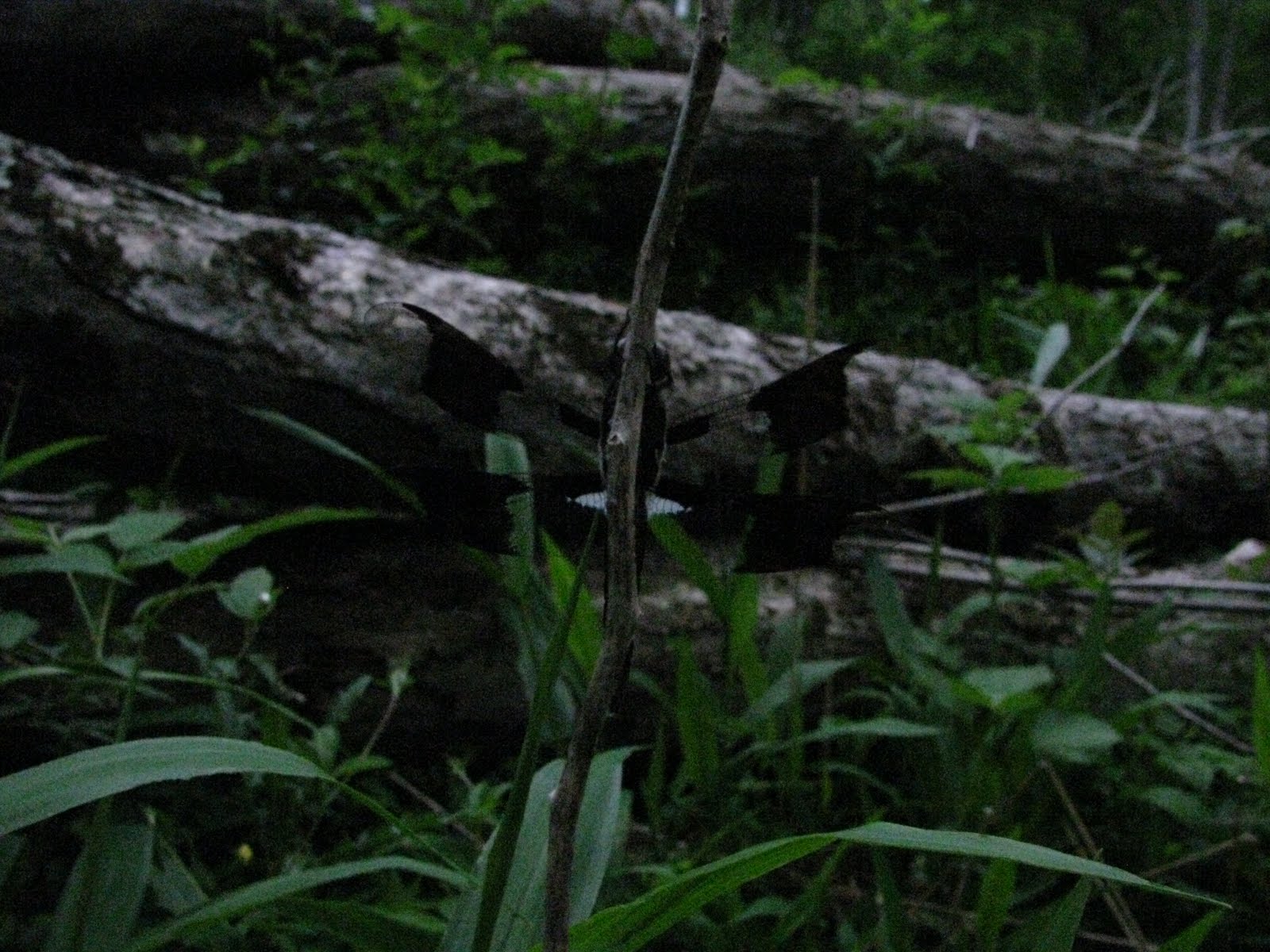
A common insect grasping a dried broken stick gains an extraterrestrial personality.
Its black wing patches stand out like flags at a drag race.
The dragonfly holds on, allowing me to photograph it at will.
It looks different from each angle.
Its colors change with the light.  When back-lit, the wings show brown. Its head glows silver.
The light changes and silver becomes bronze.

I shine the light around and see a small, bloomless Jack-in-the-pulpit.  Some from my garden came from this area several years ago before the tract was timbered. I am glad to see that at least one ancestor survives here. Perhaps there are more.

My ankles become wet with dew as weeds on an unmown path make me long for taller socks and blue jeans instead of the anklet socks and capri pants I now wear.
But wet ankles or not, I am pleased to find a graceful fern growing amid violets and brambles at the edge of the path.

The woods are becoming very dark.  I barely miss tripping over a limb across the path so I shine the light ahead.  The way is clear.

To some people the woods are spooky at night.  We tend to be afraid of what do don't know or don't understand. I don't claim to fully know or understand the woods, but they usually don't spook me.  While, like many people I do sometimes imagine sounds to emanate from a deranged ax murderer stalking me . . .I see shapes that become goblins (whatever that means). . . I see faces peering out at me from the dark trees . . . but usually even those faces are friendly, like this tree trying to whistle. (You do see that, don't you?)

More often, instead of a place of fear, I see the woods at night as a place to discover anew what I've seen before.  To test my senses; smell night smells, hear night sounds, see the night sights.
In the night I am never alone in the woods, I don't always know what is out there, but I know it is there. It is there; they are there. We are there together; sharing the dark and bits of light.  Tonight you have been there with me.  For now we will leave the woods and venture back into the garden where we will be safe among the plants we know. What will the dark do to our familiar garden friends? That we will see tomorrow.