Showing posts with label honeysuckle. Show all posts

Wednesday, August 24, 2011

Flora

-I promised you yesterday that I would let you see the flora from Saturday's walk. I'm sure you barely slept with the anticipation so let's get started with Japanese honeysuckle (Lonicera japonica) which invaded the United States in the 1800's.  According to the Invasive Plant Atlas of the United States it is spread over most of the eastern half of the country.  The lower Mississippi states seem to have missed the scourge as has Maine (so far). I often walk with clippers to cut the honeysuckle vines off of young trees.
The path along the new woods section is lined with sun-loving plants.  I haven't identified this one yet but have my books ready. It seems that I often think I am taking a good photograph for identification but once I get home realize that I'm missing something important. such is the case here. I'll get a better book and a better look.
This Sneezeweed (Helenium autumnale), below is much more common
Next to it was this one,  St. JohnsWort?
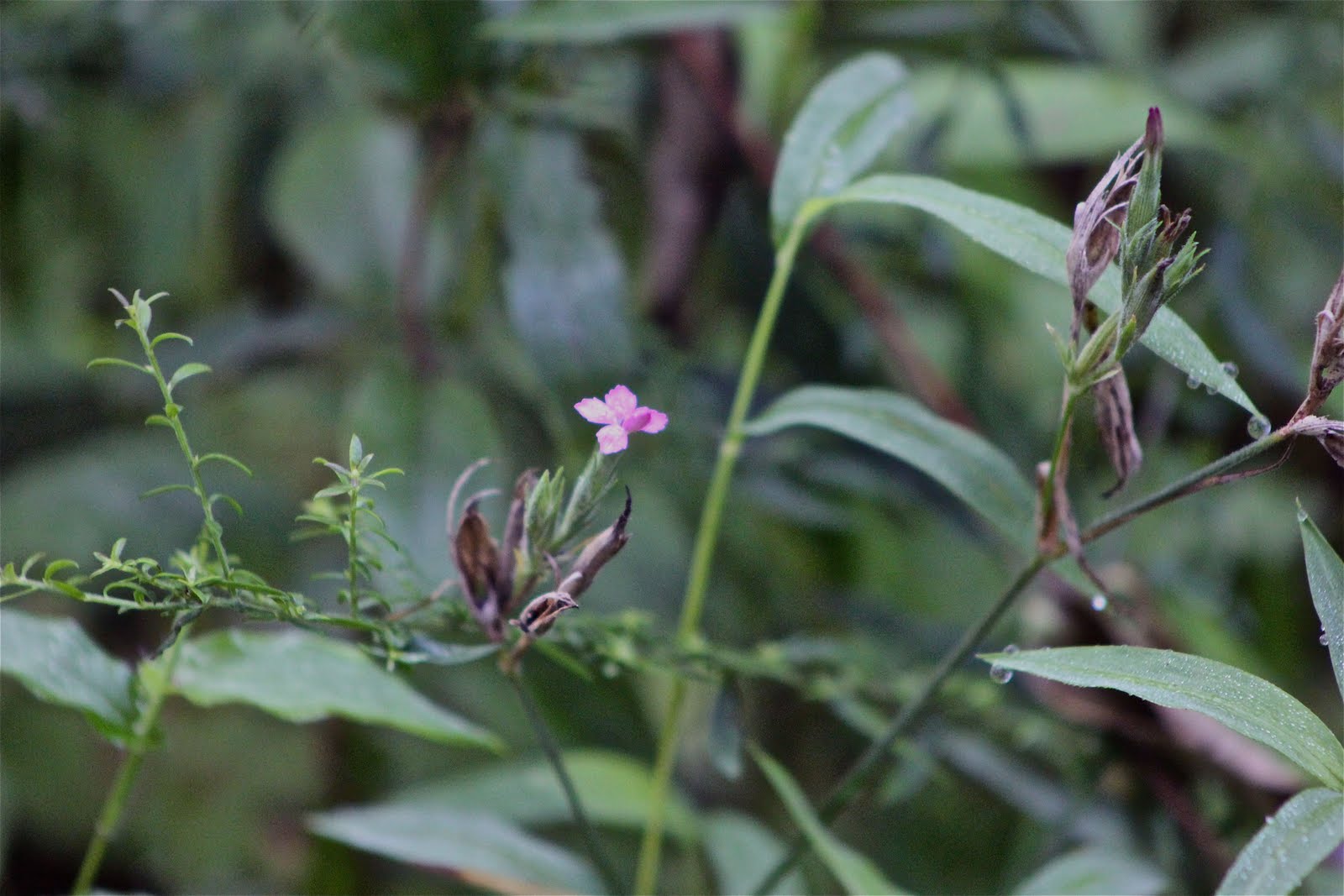
Scattered widely and hiding among all the greenery were a few pinks such as this one.
One of my favorite August plant is Ironweed. I did a whole post on it a year ago. ROYAL FIELD, written when I just had about twenty followers and I wrote it in the "small" font. (What was I thinking?) I did edit it this morning to make it easier to read. Ironweed (Veronia fasciculata) is still as regal to me as it was then.
 It isn't so great for cattle grazing, quickly spreading through a field.
Not so regal or loved is the Horse nettle (Solanum carolinense)
 This member of the Nightshade family is vicious.
The flowers are nice if you don't think about the whole plant.  In that photo above do you see the thorns coming out of the leaves? Well, now look at the stem. A field of nettles is not inviting at all. Woe to those who walk through in shorts and low socks. OW!  
I will leave you now until tomorrow when we will see a few more plants as we head across the hay field toward home.


----------------------

Wednesday, May 19, 2010

Night Walk Continues

Let's continue our night walk through the woods for one more day. That is about all the time we have left before the sun goes down completely.  Things look different at night when we lose familiar backdrops and surroundings. Grass becomes art
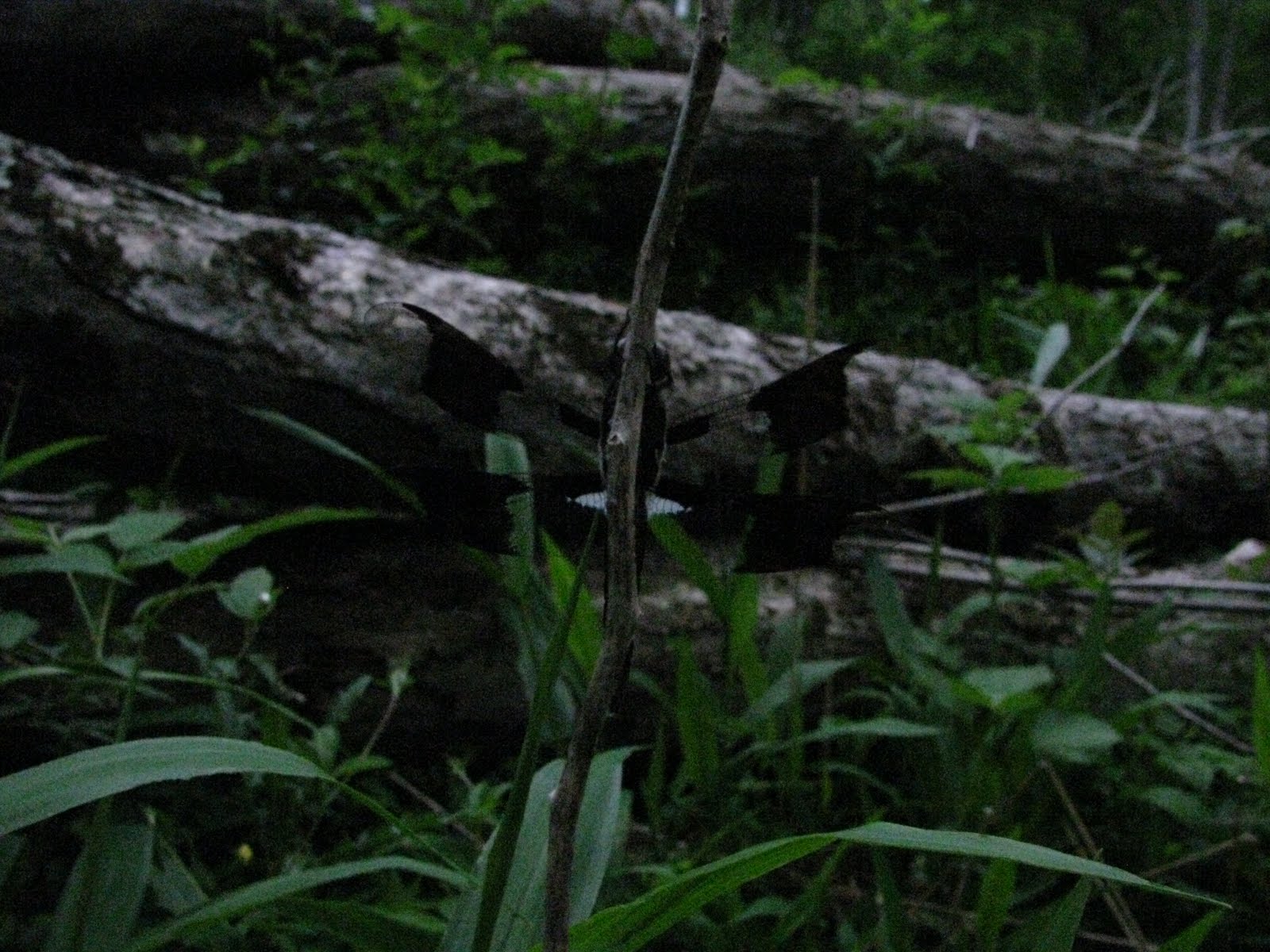
A common insect grasping a dried broken stick gains an extraterrestrial personality.
Its black wing patches stand out like flags at a drag race.
The dragonfly holds on, allowing me to photograph it at will.
It looks different from each angle.
Its colors change with the light.  When back-lit, the wings show brown. Its head glows silver.
The light changes and silver becomes bronze.

I shine the light around and see a small, bloomless Jack-in-the-pulpit.  Some from my garden came from this area several years ago before the tract was timbered. I am glad to see that at least one ancestor survives here. Perhaps there are more.

My ankles become wet with dew as weeds on an unmown path make me long for taller socks and blue jeans instead of the anklet socks and capri pants I now wear.
But wet ankles or not, I am pleased to find a graceful fern growing amid violets and brambles at the edge of the path.

The woods are becoming very dark.  I barely miss tripping over a limb across the path so I shine the light ahead.  The way is clear.

To some people the woods are spooky at night.  We tend to be afraid of what do don't know or don't understand. I don't claim to fully know or understand the woods, but they usually don't spook me.  While, like many people I do sometimes imagine sounds to emanate from a deranged ax murderer stalking me . . .I see shapes that become goblins (whatever that means). . . I see faces peering out at me from the dark trees . . . but usually even those faces are friendly, like this tree trying to whistle. (You do see that, don't you?)

More often, instead of a place of fear, I see the woods at night as a place to discover anew what I've seen before.  To test my senses; smell night smells, hear night sounds, see the night sights.
In the night I am never alone in the woods, I don't always know what is out there, but I know it is there. It is there; they are there. We are there together; sharing the dark and bits of light.  Tonight you have been there with me.  For now we will leave the woods and venture back into the garden where we will be safe among the plants we know. What will the dark do to our familiar garden friends? That we will see tomorrow.

Tuesday, January 5, 2010

Textures and Shapes

Shape and texture make our lives more interesting.  We want our homes to be decorated with different shapes and textures.  The ultimate in shapes and textures may be found in the woods.  Trees give us most of this, more so in woods rather than the forest. 

What is the difference? Technically, there might not be a difference, but to me, the forest is a larger tract of trees not usually broken up by clearings, hay fields, gas lines, power lines and numerous roads.  Woods gain their character from these same things.  Woods are easily accessible though parts must be reached on foot.  Sometimes the woods may be only part an acre of trees that have escaped the axe or bulldozer. 


In the woods, trees have a chance to spread out in some places, grow tall and branchless in others.  Woods are not usually well managed, often shaped as much by chance as by any human plan. 


Chance  wraps honeysuckle vines around the trunks of saplings, strangeling many of them, but allowing some to mature, deformed, yet growing in girth until the atached vine can breaks.

  Chance breaks tops off of some trees in storms, or allows two trunks to grow side by side like cojoined twins growing together until sometimes they appear as one.


None of this would be allowed to happen a polite well-managed forest.  One of the things I love about the woods is that a cherry tree may grow next to a sugar maple.  A thorny locust may grow next to a stately oak. 
The woods are like America, full of trees of every color and use.  One tree may have a bark or needles that makes great mulch.  Another might be used to make syrup or dining room tables,  Still another has wood hard enough to make tool handles. 
When I'm walking through them, though, I don't usually think of that.  During my narcissistic journeys through the woods I am only concerned about the type of shade a tree produces, or if it's branches hide a bird's nest. Will it scratch me as I pass? How did it get that shape.  How many people have written their names in the bark? 
There is an old  beech tree on our hill that says, "Chip + Pappy"  That was written long before I was introduced to those woods.  I know "Chip" and, for a couple years, I knew his grandfather, "Pappy." It's comforting to picture them in these woods, together, taking time for one of them to write their names in the bark.  I believe that most name carving does not  do long-term damage to a beech tree, perhaps no more than a cut hurts me. I have seen several trees with names that were carved more than forth years ago.
Near Hinton, West Virginia is a beech tree covered with names.  I was told that a naturalist studied it and felt that it may be over 200 years old, a solitary "old growth" tree that was protected from the saw while the trees around it were felled.  I know there are names on that tree as old as I am.

Another great thing about Beech trees is their leaves.  While the leaves are fine holding fast to a tree, They reach their full splendor in autumn when they have changed to golden yellow and have fallen to the ground.  The leaves from a large beech may last all winter, thick upon the ground.  These two photos were taken Christmas morning during my First Annual Christmas Walk.


The Christmas morning walk gave me time to observe the great variety of shapes and designs in the woods and surrounding fields.

This honeysuckle vine twists delicately around the young tree like an embrace though the tree has already begun to break free of its hold.


We don't have many large pines left in this part of the woods,  I love how its bark is so different from the diciduous trees.


The tangle of grape vines and honeysuckle appear like super-magnified dreadlocks


I couldn't resist this patch of grass.

Even the hay field joined in with S curves accentuated by the snow.


The snow was smooth when I left after feeding the birds.  A couple handfuls of sunflower seeds landed on the snow's surface.
Are these hieroglyphics or Mayan symbols?