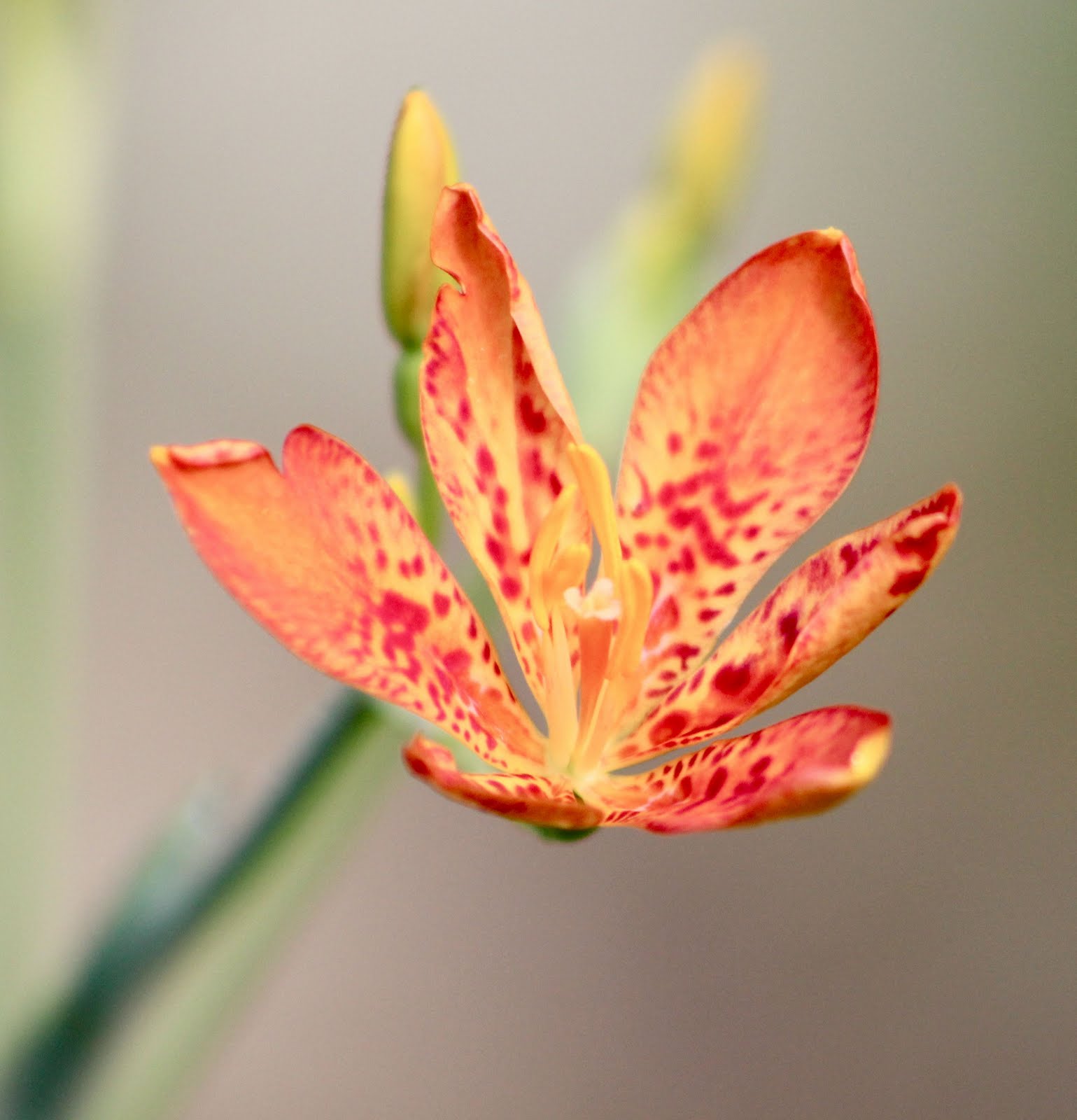
In August, plants don't make the grand entrance that gives us the great show of spring. Flowers that bloom in late July and August tend to sneak into my garden. quietly growing all summer amid the fading leaves of earlier bloomers. It seems that one day I just realize they are there covered with blooms like the purple aster or this lily below.
Belamcanda chinensis - Blackberry Lily
Not a lily at all, but actually an iris, the Blackberry lily grows wild in West Virginia. Stems and leaves first appear in June. At this point it looks like a petite iris. from between the lance-like leaves a stem appears which grows tall. Mine is about four and a half feet. The fun begins when the flowers pop out of the stem. Brilliant candy orange blossoms carry orange spots. Each petal curls slightly at its tip like a dog's ear. The budding performance does not stop with a fully open flower. Once the flower fades, it curls up on itself looking like an old-fashioned candy stick. This swirl sits atop the seed pod which continues to swell until it is filled with purple-black seeds that burst forth when the pod of broken.
Many of the spring flowers are gone by August, but Jack-in-the-Pulpit is still entertaining as it forms berries along its stem or "pulpit." First green then red, the berries draw my attention into shady spots.

The Jack's leaves have disappeared around its stalk of berries. This particular plant is part of the very first plant to become part of my garden. I was given it during a wildflower class. The tiny jack-in-the-pulpit was wrapped in aluminum foil. To me it was a rare treasure. Since then I have found many in the woods around my home and have transplanted several into the garden. Most do not get as large as this one. Several shoots and leaves emerge from the original plant. The largest one is first to turn red and drop to the ground. Its stem has dried so that now the weight of the berry head bends it over where each berry will fall to the ground at a different time. I think this gives a greater possibility that one or more of the berries will fall at the perfect time when the ground has just the right amount of moisture to allow the seed to germinate or let itself be buried to wait out the winter cold.

Other Jack plants do not yet produce berries, but do hold on to their leaves almost until frost.
Each August day brings a new surprise as plants bloom and mature intermingled with each other, just waiting for me or someone else to discover what the garden holds.