Showing posts with label banana tree. Show all posts

Tuesday, October 18, 2011

Yard Banana Tree

Yesterday I  shared a photo of my sad little banana tree beyond my garden in the New Woods Field that has been gnawed on by some animal, possibly deer or a tall groundhog.
Because several of you felt bad for that pathetic tree I wanted to share a view of the grove within my garden. This clump is getting close to ten years old. Each successive spring shows larger trees and more stalks though autumn  frost means that a quick slice from a sharp shovel brings the giant leaves with their sopping stalks  crashing to the ground where the buried root clumps will be  mulched with leaves. 
The trees below are about two stories tall.
While our season  here in Zone 6b  isn't long enough to produce actual bananas, the trees bring me tropical joy.  They are usually a fun surprise to my garden visitors.

Monday, October 17, 2011

Back into the Woods

Autumnal rain fell with the leaves yesterday and the day before but today misty drops were replaced by a sunlight shining golden through my morning window.
Pulling my hiking boots from the closet, I laced them up then after tying a double knots I joined the sun.
No, it is obviously not native but yes, I planted a banana tree in the field near the New Woods.
It grows very slowly in the poor soil. If it ever poses a threat of invasion I will simply mow it down or dig dirt away from the roots. It is barely hardy in our area and spreads only by growing a larger root mass.  I approached the tropical foreigner and noticed something interesting.
Something was eating the banana leaves. It was something with teeth, not bugs. I was curious since it  is a non native and the leaves are so very tough.  For now it will remain a mystery.
There is some summer color remaining in the woods. First, I spied a couple violets.

Some small white asters and the larger Wood aster (Divaricatus)


as well as a flower as golden as this morning's sun, Wingstem (Actinomeris alernifolia)
We have seen plenty of honeybees this year - a welcome sight.
As I walked on I saw a spot of woods poking out from under some brush.  Do you see it?
Look a little closer
I'm pretty sure it is a large Jack-in-the-pulpet but I really want it to be Ginseng.  All the Jack-in-the-pulpets I've seen in this area are a small type with small berry stems. I think, though, that the way it is clustered on the stem is particular to Jack-in-the-pulpet.  The examples of Ginseng I have seen are more rounded clusters.
Aw, well, it is time to take a last look at the woods and turn toward home do some chores.
don't fret, we'll go out at least one more time before all the leaves are gone.
-------------------------
Once again,  I am including the link to this album below because I heard the band last weekend and loved it.  I wish you could have heard them.  One day you may hear them on the radio. HaHa Tonka is named after a park in Missouri.  They are Indie Folk/Rock with an unbelievable 4-part harmony on some of the a cappella tunes.  they are full of youthful enegry which they mesh with traditional Ozark Mountain music sounds. Once again, I am includeingthe link to this album below because I heard the band last weekend and loved it. 

Monday, April 19, 2010

Butterfly and Banana

 I try to focus quickly on a butterfly alighting for a moment on the lavender phlox, for quickly it will flutter off while I am still trying to find it in my lense.  In the spring garden, a few seconds is all the swallowtail will offer a bloom before setting off across the yard for another plant. Do the cool short days of spring effect nectar so that the butterfly is not encouraged to linger?  It just seems to me that they tarry a bit longer further into summer before moving on to another bloom, giving me more time to catch a photograph. If it is true then the combination may allow for a stronger chance at survival during spring when there are less food choices for birds. Moving right along gives birds less chance to swoop down and gobble up a brightly painted morsel.

I've really been looking forward to butterfly season this year.  For Christmas my brother gave me a wonderful little butterfly book, A World of Butterflies by Brian Cassie with photographs by Kjell Sandved.  Each two-page opening is dedicated to a particular butterfly with the name and description on the left page and a gorgeous photgraph on the right-hand page. I am now anxious for someone to offer me a free trip trip to Brazil so that I can witness a morpho portis butterfly in flight. It just won't happen for me here in West Virginia.
On the strong chance that I don't make it to Brazil for a Morpho visit, I am very satisfied with the swallowtails and monarchs that do pass through my yard.

Last week it was white dogwoods and this week it is the pink.  My Arbor Day Foundation tree is blooming.  One of ten received with a subscription to the Arbor Day magazine over twenty years ago, I am lucky to have this tree at all.  It struggled to survive its first couple years as a tiny sprig planted in clay soil during a particularly dry period.  It finally seemed like the tree would make it when the 17-year locust attack came. The small limbs were riddled with tunnels drilled for locust eggs, causing them to break off right where they should have been the strongest.  Jeff was ready to mow right over the tree when I pleaded its case.  I have a weak spot for crippled plants that show any sign of life.  I convinced him to give it another year.  The next year showed a few leaves and the next year one -yes ONE bloom.  Today it is a focal point of my spring garden having survived yet another once-every-seventeen-year attack.

This week, also finds my garden graced with pale blue blooms from wild phlox transplanted from a nearby hillside.
A year ago I found myself amid a dozen bright yellow calandine poppies growing in a damp woodland area. Nearby I found another group. Two plants were moved into my shady periwinkle bed where they have flourished beside the wild ginger, rewarding visitors with new plants and glowing golden blooms.

The banana trees are still trying to grow, despite several frosts which have nipped their leaves.  They are almost a month ahead of schedule. Last fall, as you may see, we mulched the banana trees heavily with raked leaves. This may have worked together with this year's uncommonly hot spring days to convince the trees to come up early.  last year a man who claimed to know such things told me that if I would cut down some of the trunks, limiting the trees to just one or two, the bananas would likely bloom.  Our season is too short for any chance of fruit, but with fewer trunks to support we might get lucky with some blooms.  Maybe I'll try it this year.  I have some friends who would probably like a plant.  That would be much better than just cutting it off and tossing it out.

Wednesday, April 7, 2010

Warm Days

Six o'clock in the morning.  Seventy-five degrees. April. Something isn't quite right. Remember, "April showers bring May flowers?"  I am already watering some of my blooming shrubs because the ground is drying out quickly. It is too hot to work in the yard in the afternoon.  Oh, why didn't we build a pool instead of buying a camper?
Actually, the warm weather has been nice though I do worry about its effects on the plants. And we know the heat won't last.  There will probably be several more frosts before the heat moves in for the summer. It is just such a surprise for April. Tomorrow things will cool down acording to the television weather report.  We'll see.
The heat has already affected some plants.  The banana trees are up two weeks early.  They won't make it through a frost which must surely come.  I'll have to be sure and cover them up warmly on those cold nights. 

My epimedium is up and going strong. The epimedium's heart-shaped leaves are green, tinged with red and sit atop thin, delicate stems which also support its exotic flowers.   This japanese garden staple with roots in China is known by a few other names, more common in Europe. One particular name, horny goat weed comes from shepherds noticing that their goats became even more sexually active than usual after feasting on a patch of the plant.  (At least that is the legend.)  There have been some more modern experiments on its aphrodisiac possibilities.

I have little fear of goats eating mine.  It rests under the outer edges of a spruce tree, just barely in the sun.   Every time I see it I think of my mom's friend Trish who insisted that Mom bring the plant to me.  From Mom's description of my garden, Trish was sure that it was the perfect specimen.  I do like it.  Some descriptions call it troublesome for spreading too quickly but that doesn't seem to be a problem in my dry clay soil.  I also use the plant to mark a diminutive verigated hosta which grows beside it. 

The hosta is five years old and never reaches more than a few six inches in diameter.  I took it from a full-size specimen that was becoming overgrown in a business landscape planting.  It grows near other hostas that reach full size so it is either a mutation or needs more sun.  I'll try transplanting it this year if it shows up again.
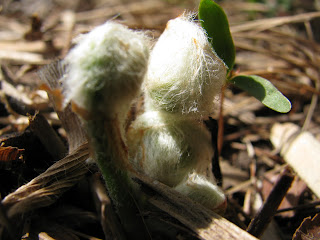
I'm excited to find the fiddleheads of two ostrich ferns I transplanted from the woods last spring.  I don't have much water for my garden and in August the ferns dried away to almost nothing causing me to believe they had died.  Last spring we found three groups with three ferns each, growing along the gas right-of-way.  I took one waist-high fern from each group.  Whenever taking a plant from the wild, I always make sure to leave a stable colony behind.  While I probably should have taken less ferns, I'm was afraid that they would soon be mowed down by the gas company.  The ferns were right on the border of what they mow and sure enough, they mowed last fall but probably late enough to ensure that the ferns will return as did the ones now residing in my garden.

Wednesday, November 18, 2009

The Day Leaves Darkness Behind

The call of Red-bellied wood peckers pierce the morning
As the focal sphere pierces the dawn,
fighting obliteration by clouds promising a shower.

The clouds give way allowing the sun to blind and bathe me.
Even as drops of water
compete with the light for a spot on the grass.
I hear the drops but as yet only feel the sun.

The birds, too, ignore the tapping rain
calling to each other;
The raspy nagging of the titmouse,
The distant caw of my friends, the crows,
and the closer deep squeak of the nuthatch
as it heads downward on the dark trunk of a lichen-covered oak.

This morning I knew I needed to hurry if I wanted to beat the rain, so I dressed quickly, grabbed a couple cameras, and a chair then almost sprinted up the small hill in the field arriving just in time to welcome the sun.

Setting my chair beside the small impression where, beneath several feet of dirt, lay Peach, eternally sleeping on her flannel-covered dog bed surrounded by her toys and stuffed animals, I relaxed knowing good things would follow. 

I thought of Peach, a long lost friend, who gained her name when I misunderstood my daughter as she tried to call the new puppy "Petrie." The name fit her though, for soft and sweet she was, lounging by the side of her family as only a hound can do.  That relaxed, body would stretch the length of a bed, hiding the potential energy which easily could outrace a car or my husband chasing her after planning to lock her in the house while we attempted a family outing, leaving her behind.

Many mornings I had sat at this very spot with Peach leaning against my thigh as we watched the world together. 

This morning, once the sun had blazenly risen, then retreated behind the gray clouds, I walked back to the house through the garden. Though we have had several frosts, and even a hard freeze, the cold has been followed by several weeks of warm nights and sunny days.  My garden is attempting to defy the shortening days.  There is new growth everywhere.  Japanese painted ferns have resprouted, perhaps drawing heat from the rock which serves as a backdrop to their fall showing of silver, green and maroon. I welcomed them as I would welcome an unexpected guest on a dreary morning.

Even the banana trees speared their way through a mulching of leaves. I cut them down three weeks ago fully expecting the trees to go dormant.  I wish now that I had protected them from the freezing temperature, allowing the tropical plant to mature a bit longer.  I see my friend, Melonie, in Georgia, has cut fruit from her banana trees this year.  If the warming trend continues a few more years, perhaps we'll even have some bananas in the mid Ohio valley.  
I love these banana trees. It is because they are so incongruous here in West Virginia.  They found their way into the garden a few years ago when my mother and I visited The Glass House Works in Stuart, Ohio.  The Glass House Works is a nursery that sends unusual plants  to other nursuries all over the world.  Through the years I have visited it frequently gleaning ideas and plants. At one time the owners had a very ambitious Japanese style garden situated between two old homes. By Japanese, I don't mean the Zen, minimalist style garden.  No, this garden was full of plants.  It was shaped by the idea that every inch should be occupied by planned growth. Every nook and crannie had a plant wedged in. Paths led us across bridges, around small ponds and to dead ends that were anything but dead.  The wonderful messy-ness whelmed with growth.  I was inspired.  My own garden plans were reinvigorated. 

It was on one of these visits that a worker introduced me to a variety of hardy banana tree that the owner had discovered.  They had two small plants for sale for $10.00 each. I took one with instructions to be sure to mulch thickly each winter then keep watch in the spring.  That first spring, about five years ago, rewarded me with a banana tree that grew about 10 feet tall and even multipled.  Since then every summer brings more trees.  This spring I transplanted one to a mowed sunny spot  out in the woods.  Hopefully, next year visitors may be surprised as they walk the wooded path then come upon a bit of the tropics.  I'll let you know what happens.