Showing posts with label Williamstown WV. Show all posts

Wednesday, July 27, 2011

The Williamstown Wetlands

Grab your handkerchief. We will be hot. Today I'm taking you to The Williamstown Wetlands.

Located in Williamstown, West Virginia on Highland Avenue, The Williamstown Wetlands are on property owned mostly by DaVinci's Restaurant. DaVinci's has leased the land to the Williamstown Women's Club who are developing the small wetlands into an observation, study and sanctuary site.
The best parking is behind the restaurant where we will find the beginning of a wide trail that circles the wetland. 

     Volunteers, led by Betsy Caltrider and Rita Stephan of the Williamstown Women's Club, have begun building a boardwalk over the wet areas of the trail.  Today we will head left onto the completed part of that boardwalk.  Let's pause at the observation deck.
Sagittaria or Duck potato covers a large area before us.
With plenty of Narrow-leaved cattail (Typha augustfolia) around.
Looking toward our left we see the far end of the wetland.
looking down, just beyond the observation deck, we are met with "the in-between" - that area where dry fades into wet.
Back on the trail there is plenty to see also.  Volunteers planted some of the surrounding plants such as 
Button bush  and Pin oak but there is a good chance that this sweet-flowerd thistle was planted by Nature.

They also put up bat houses. If you ever lived near a wetland you know about mosquitoes.  Bats will eat thousands of them. It seems only fair to provide them nice lodging. Do you see that board at the bottom of the house? Evidently bats need a rough, flat place to crawl up into the house. 
Swallows and bluebirds will help control the insect population, too.

Today, though there is very little activity by anything. Humidity is heavy enough to convince us that we are part of the swamp.  Mosquitoes are the only life with enough energy to overcome the heat-induced inertia that has affected us all.   My glasses fog . . . my camera eyepiece fogs between it and my glasses . . . my brain fogs.  But the four o'clock light is actually not too bad here at the wetlands so let's keep walking.
Further along the gravel path we see Teasel (Dipsacus),
. . . both naked and dressed.
There's a Mallow (Hibiscus), some sort of Swamp mallow I assume because, after all, we are in a swamp.
 On the woods side of our path there are plenty of blackberries,
Field mint (Mentha arvensis)
and Wild grapes (Vitis rotundifolia). According to several internet sites, our Wild grapes are the same as the Scuppernongs and Muscadines prevalent in trained rows in so many back yards of the southern United States.
A nice thing about the Williamstown Wetlands is that there is already seating available in the way of benches provided by area businesses.  
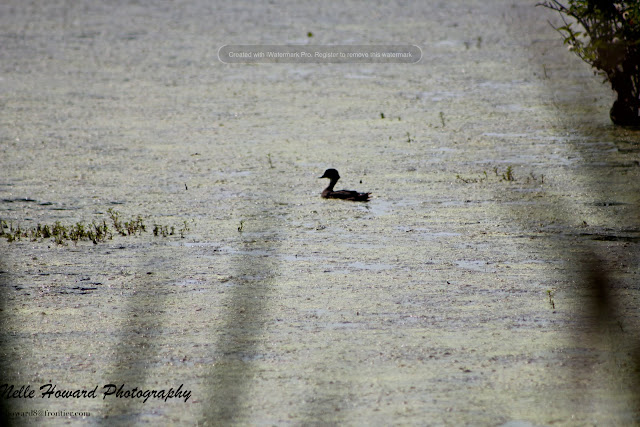
These benches will be great - on cooler days - to sit and watch the songbirds and migrating ducks. Today, though, there are just a couple ducks that have ventured out from the shade.
Today is NOT one of those cool days, so as I, once again wipe the fog from my glasses, we shall return to our path. The air conditioned car will feel good and will quickly revive us so that we forget the heat and only remember the quiet, verdant beauty of The Williamstown Wetlands.
check my store at the link, above for books about the wetland.

Tuesday, May 3, 2011

Painted Turtles

In past blog articles we have learned about spring ephemerals but we also have ephemeral ponds. 
 . . . and water that behaves like an ephemeral pond.  An ephemeral pond is one that comes forth in the spring due to more frequent rainfall associated with the season.  It becomes home to fauna that must act quickly to take advantage of what the pond offers. The short-lived spring pond offers breeding for amphibians and is an important link in their life cycle.  
River backwater and wetlands often act like ephemeral ponds in that spring rains fill them beyond their normal boundaries providing fresh water and a chance for plant life to surge in growth which, in turn, provides more abundant and varied food for animals that inhabit the wetland.
Painted turtles ( Chrysemys picta) like the ones shown in these photos make good use of ephemeral ponds.  They eat and procreate until the wet season ceases causing the pond to dry up.  The painted turtle then leaves, often crossing long distances of dry land in search of another wet spot.  While perfectly suited to life in and under water, the Painted turtle does very well on dry land.
It is a bit different for swamp turtles. Living is a wetland such as a swamp allows a Painted turtle to take advantage of spring rains, with its accompanying plant growth, without having to expend energy moving to a new location since such wetlands seldom dry up completely.  
 After a winter spent mostly buried in mud, it must feel good to swim to the surface, climb up on a log and feel the sun upon your shell. Painted turtles don't seem to mind the "slime" and duck weed that accompany them whenever they surface.
While Painted turtles breath and even absorb oxygen while underwater, it  must be easier to breath out of the water. I don't know, but imagine that it would be a bit like us putting on an oxygen mask to receive purer oxygen than we normally breath - just easier.
A Painted turtle has a long neck that it can stretch far out enabling it to reach food without coming out of the water.  Its flat, dark shell blends in perfectly with the dark water surface, normal to still water.  
These turtles you have seen today are enjoying their life at the Williamstown Wetlands, in Williamstown, WV.
--------------------------------------------------------------


Wednesday, June 23, 2010

Country Roads

Today I'm going to take you for more than just a walk "beyond my garden." Today we're going for a drive.
Many states plant wildflowers along their roadsides and West Virginia does that too along sections of the interstate highways.  I think it is a great idea but here in the Mountain State we don't really need to plant wild flowers.  All we need to do is time roadside mowing to allow what is already growing to bloom.  If you have ever flown over the Appalachian Mountains after being in the arid West, then you know how the eastern mountains look like a jungle by comparison.  We have to keep mowing or scything or running a weed-eater just to keep things under control. A two-week vacation during the wrong two weeks may mean that you cannot find your front door upon your return. 
 This, in no way is to lessen the beautiful blooms of western wildflowers with their extravagant colors and varieties. Our flowers are just so intermingled and fast-growing that we natives sometimes see them as weeds.  We often see their beauty as common while we hurriedly pass by on our highways and byways.

This year, flowers are all blooming early which means that along with a later mowing schedule, our secondary highways are frequently lined with  a whole pallet of color besides green.  This is the time of year that I am thankful for land owners who have let their banks and berms grow. The pictures to the right and below portray my favorite highway combination - Queen Anne's Lace mixed with chicory.  The pale blue of the chicory blends in with Queen Anne's Lace like a baby boy's blanket resting beside the hot pavement. From 8:00 - 10:00 a.m. this combination is at its peak.  By 1:00 p.m. many of the chicory blooms have closed up leaving the white Lace to stand alone.


Other spots find daisies mixed with yellow mullein, pink vetch and a tiny yellow flower I did not identify.
Thistle is getting ready to bloom while beneath them all, coltsfoot leaves become enormous securing the energy they need to bloom in the early spring.


All these are mixed nicely with a brilliant splash of orange from day lilies, escaped so many years ago that they are now wild. Our river banks and highways have welcomed the tubers to every damp spot.

Even the most non-observant car passenger must notice the lilies.
I hope you have enjoyed our short drive along state route 31 near Williamstown, WV.